Showing posts with label conservation. Show all posts

October 25, 2008

Lake Lanier, One Year Later

Every now and then I look back, just to gain perspective on where we are now.

Back in October of 2007, Georgia was in the middle of a drought: one of its largest reserves, Lake Lanier, had dropped dangerously low.

The thing that was striking about this shortage was that the Army Corps of Engineers seemed totally oblivious to the problem, much like John McCain and his Sara Palin problem.

Here's a relevant snip of the post:

****************************
Major Daren Payne of the Army Corps of Engineers wrote a letter to the Governor, stating that Georgia was "not going to run out [of water] any time soon." He's the deputy commander for the district that oversees the lake and the dams in the area. And he seems to be some kind of idiot.

Hey, Major Moron, here's a reality check for you:

On the left is a picture of the East Point Reservoir, taken about a year ago.

On the right is a picture of the SAME reservoir, taken last week.
Notice something? Like the LACK of WATER? I'd certainly classify it as "running out of water."
***********************************

Major Daren "Moron" Payne actually responded to this post! I'm going to interperse his comments with my responses:
Major Daren Payne said...

Just to clear the record and make sure everyone has the correct information I'd like to point out several indisputable facts regarding the drought situation and Lake Lanier water supplies:

1. There are over 280 days of water left in Lake Lanier assuming no change in current consumption levels and that we get NO precipitation whatsover during that time period.

Bragging that you have a supply that won't last even as long as the current drought has run isn't very reassuring. And with the rainfall record over the last two years, counting on rain isn't the smartest thing I've heard. Assume the rain fall continues the same rate for the next year: how long will it take to replenish the lake? Hmm, NEVER, that's how long, under the current trend.

2008: the water level has risen four feet since this post: but that is after it fell four feet. which leaves the lake where it was a year ago.

2. Lake water below the conservation pool (i.e. the dreaded "dead pool") has been tested by local labs and is within normal drinking water quality specifications.
Did I address water quality in my post? I did NOT. Not sure why you're bringing it up.

2008: I now realize it's a "talking point" he was instructed to introduce. Kinda like Sara Palin does anytime she's asked a question about anything relevant to her qualifications as VP.
3. Lake Lanier has not yet hit it's historic low. In fact, although this drought is the worst in history in terms of intensity and duration, we are still four feet above the all time low for Lake Lanier recorded in 1981 when the population drawing water from the lake was about 1/3 of what it is today.
I stand corrected about the historical low. I guess I'm about four months early.

2008: Actually, I was only four weeks early. It beat the 1981 record (1,052.7) on November 19, 2007 when the lake dropped to a depth of 1,051.98. It continued to drop until February, at a final record low of 1,051.79 feet.
4. The pictures in this article, while alarming to say the least, are pictures of a small, shallow cove in one area and certainly not indicative of the overall situation at Lake Lanier. In fact, over 65% of the total volume of water that the Corps can retain in Lake Lanier is still in the lake.
So, the lake is at 65% of its capacity? Hmm, that's 35% empty or less than 2/3 of its volume. This is supposed to reassure anyone? The guy who's walking cross his old fishing hole should sleep much better tonight, huh?

2008: It's a small, shallow cove if it's got water in it. If it's got no water, it's a dried-up lake bed.
Thus, while we have a serious drought and a very serious long term water management problem for the entire Southeast, I'd say the Corps has done a pretty good job of managing a scarce resource in the face of exceptional drought, massive urban growth and in the face of no less than a dozen lawsuits from three different states.
You've got a problem looking at reality, Major. Fending off a dozen lawsuits isn't a sign of success. Particularly when it is STATE GOVERNMENTS doing the suing. If you're successful, why would anyone sue?

So for know, I'm afraid you're still "Major Moron" to me. But at least you got balls. I may question your wisdom, but you got the courage to stand for your convictions. I wish I found that reassuring. I do not, and neither, apparently, do the people in three states who've filed a dozen lawsuits.

2008: Since this post, the water level has risen above the record lows of February 2008, but the lake hasn't risen above 1,055 feet. And in the face of Sara Palin, I no longer credit Payne with having balls: He's an idiot.

The Army Corps of Engineers was removing water from the lake faster than it was coming in, and doing this during one of the worst droughts in the region's history. I can only hope that he has been removed from public service as the incompetent hack he is.

June 2, 2008

US Automakers and the GOP: Dumb and Dumber

The banner on the New York Times article is a statement of the obvious:

The Huge Hybrid: a New Twist on S.U.V.’s Finds Few Takers

You'd thing that taking a bloated gas guzzler and making it more efficient would be a good thing. And it would be, if these oversized junkers were being brought up to a reasonable consumption rate of other automobiles.

But in fact, GM and Chrysler are only moving the line from "terrible" to "very bad."

I'm not surprised that GM could believe that 20 mpg is good mileage; it's disappointing that Chrysler is no better.

American Automakers started screwing over the American public when it started building these behemoths. While the Big Three disingenuously claim they were simply selling the public what it wanted, the fact is that GM and Chrysler and Ford initially started building them because they were exempt from the federal fuel consumption and emission standards imposed on passenger cars.

SUVs were exempted because they were a small, niche market. But automakers realized that if they pushed SUVs over passenger cars, the profit margins would be higher because of the lower standards for SUVs.

Now we're all paying the price; gas is over four dollars a gallon.

We faced fuel shortages in the 1970s. We had become dependent on foreign suppliers to run our country; foreign fuel powers not only our cars and trucks, it powers our trains, our navy's ships, and even our power plants.

30 years ago, initiatives were proposed to reduce our dependence on foreign fuel; our cars and trucks were to become more fuel efficient. Electrical plants would find alternative power sources. Homes would be built to make use of the sun's energy, and to maximize the use of commercial power.

But then Ronald Reagan came into power, and those initiatives went out the window.

"Trains are not any more energy efficient than the average automobile, with both getting about 48 passenger miles to the gallon."
--Ronald Reagan, quoted in the Chicago Tribune, May 10, 1980. (The U.S. Department of Transportation calculated that a 14-car train traveling at 80 miles per hour got 400 passenger miles to the gallon. A 1980 auto carrying an average of 2.2 people got 42.6 passenger miles to the gallon.)

Reagan's policies regarding energy consumption were dreadful. Because he didn't bother to acquaint himself with the facts, he kept working against our nation's best interests in regard to to its energy programs.
"I've said it before and I'll say it again. The U.S. Geological Survey has told me that the proven potential for oil in Alaska alone is greater than the proven reserves in Saudi Arabia."
--Ronald Reagan, quoted in the Detroit Free Press, March 23, 1980. (According to the USGS, the Saudi reserves of 165.5 billion barrels are 17 times the proven reserves--9.2 billion barrels--in Alaska.)

A lot of subsequent GOP proposals have revolved around simply drilling into untapped reserves located in national wildlife preserves. Instead of taking a hard line on making better use of the fuel we have, Republicans believe it's better to destroy what little original biosphere we have left to squeeze out a few more gallons of gasoline.
"We should have been exploring for oil and gas in ANWR. But, no, we madethe decision and our Congress kept preventing us from opening up new areas to explore in environmentally friendly ways and now we're becoming, as a result, more and more dependent on foreign sources of oil."
--George W. Bush, quoted by Reuters News on April 29, 2008. ( The Energy Information Administration, estimated that if Congress had cleared Bush's ANWR drilling plan the oil would have been available to refiners in 2011, but only at a small volume of 40,000 barrels a day -- a drop in the bucket compared with the 20.6 million barrels the U.S. consumes daily.)

But views of the GOP regarding the value of drilling is contrary to reality. The largest untapped oil field in the continental US is the Bakken Formation. The USGS believes that there is between three and four and a half billion barrels of oil there. Sounds like a lot of oil, doesn't it? For some countries, it certainly would be. But that represents at most a seven month supply for the US at current rates of consumption.

If we're going to risk destroying habitat for oil, shouldn't it be for more than a few month's grace to drive oversized trucks or run our air conditioners? Would you cut off your arm, even if it wouldn't save your life?
"The disparity between increasing production and declining reserves can have only one outcome: a practical supply limit will be reached and future supply to meet conventional oil demand will not be available."
--U.S. Department of Energy, Office of Deputy Assistant Secretary for Petroleum Reserves, Office of Naval Petroleum and Oil Shale Reserves, March 2004
The automakers have painted themselves - and us - into a corner by investing so heavily into the production of vehicles that are destroying any hope of energy independence in the US. They should be dumping the SUV program almost entirely, and should be doing what they should have been doing for the last 30 years; improving fuel efficiency from one year to the next. Cars produced in the 1980s had better fuel economy than the junk being pushed on us by Detroit today. Had the Big Three maintained the principles laid out by Jimmy Carter in 1977, we'd be getting 50 miles to the gallon by now.

And if the GOP hadn't shirked its responsibilities to the public, we'd have useful mass transit in all our urban cores, and wind farms in every state.

We were once on the way to being the most technologically advanced nation on the planet; the policies of our politicians over the last three decades have reduced us to desperate parasites.

Thanks, Republican Party! Thanks, US Automakers!

May 7, 2008

On Political Power, Clout, and Compromise

When George Herbert Walker Bush was running for President, he made a promise that swept him into office:
“ And I'm the one who will not raise taxes. My opponent now says he'll raise them as a last resort, or a third resort. But when a politician talks like that, you know that's one resort he'll be checking into. My opponent, my opponent won't rule out raising taxes. But I will. And the Congress will push me to raise taxes and I'll say no. And they'll push, and I'll say no, and they'll push again, and I'll say, to them, ‘Read my lips: no new taxes.’ ”

Of course, he did sign the largest tax increase in US history up to that time. It cost him much support during his administration, and utterly destroyed any chance at a second term in office.

Arguments have been made that he had to sign the bill into law in order to hold onto his political clout; after all, it was clear that Congress had the votes to override a veto. Presidents whose veto gets overridden, we are told, loses political power.

But the man made a promise, and the bottom line is he broke his promise. And people who break promises don't deserve any support from anybody.

Why am I bringing this up? Isn't this water under the bridge? No, not in light of recent events.

Miami-Dade Mayor Carlos Alvarez made a promise to the people of Miami-Dade County. He promised that he would fight urban sprawl and stand against the corruption of out-of-control developers. And he faced his greatest test so far with the incredibly stupid request to move the UDB (Urban Development Boundary) farther west.

Despite the fact that State and County regulatory agencies recommended against the move, and a lack of support in the community, the clowns in our county commission voted to do it anyway. Alvarez warned that he would veto the move, and the overwhelming majority of jackals on the commission retorted that they would overrided.

They voted for the move. Alvarez vetoed it, and the Commission, unfettered by intelligence, common sense, or decency, overturned it.

Some might argue that this cost Alvarez some political capital; they would be wrong. The fact that Alvarez kept his word knowing that he would ultimately lose the battle only underscores the strength of his integrity and the courage of his convictions. When you give your word unequivocally, you can not compromise.

Plus, when the Commission is forced to spend tens of millions of dollars defending the lawsuits that are being filed as I write this, the guy who tried to stop them is going to be the one standing on the moral high ground.

Mayor Alvarez is absolutely correct when says that this defeat is Miami-Dade County's. And as long as Joe Martinez, Natacha Seijas, Audrey Edmonson, Rebeca Sosa, Dorrin Rolle, Bruno Barreiro, Barbara Jordan and Javier Souto continue to sit on the Commission, we will continue to be the losers.

Lowe's List of Cockroaches: Their Board

I listed the scumbags on our own Miami-Dade County Commission, it's only fair to spotlight the cockroaches that will be destroying our drinking supply and savaging the Everglades.

The Directors of Lowe's:

David W. Bernauer
Leonard L. Berry
Peter C. Browning
Dawn E. Hudson
Robert A. Ingram
Robert L. Johnson
Marshall O. Larsen
Richard K. Lochridge
Robert A. Niblock
Stephen F. Page
O. Temple Sloan, Jr.

Be sure to tell them how feel: you can use this form.

April 11, 2008

Fund Tri-Rail, not Highways.

A few months ago, I did some budget review, and discovered what transit experts had been saying all along was true; it's cheaper to leave your car at home. And that's true now more than ever.

A few years ago, when I looked into using Tri-Rail, it did cost less than driving, but only by a small margin. Now that gas prices are up to $3.45 a gallon, that margin has drastically increased.

Unlike too many of you, I don't drive a gas-guzzling SUV. I have a very basic Chevy Cavalier, and it gets about 28 miles to the gallon in South Florida Traffic. I live 30 miles from where I work. When you factor in tolls, maintenance, and insurance, I spend about $12.00 a day to drive to and from work. I can make the same trip via bus and Tri-Rail for $6.50.

Let's crunch the numbers; I'm saving $5.50 a day, times five days a week is $27.50, or about $118 a month. Over the year, less my two weeks vacation, that's $1,375.00 in savings.

That really isn't chump change, is it? It's like getting an extra couple of weeks' salary for me.

And if you're driving an SUV, or big-ass gas guzzler, you'll save more than me.

(As far as I'm concerned, the ONLY reason to drive an SUV is if you're hauling crap over uneven terrain and to help fund terrorist organizations in the middle east. But that's another blog entry)

I'm not the only one who has discovered this; Tri-Rail ridership has increased 32% from last year, which translates to 10,151 passengers a day.

The other day, a co-worker was trying to figure out how to get her sister to the Miami Airport from Aventura in rush hour traffic without missing several hours of work to do it. I handed her a Tri-Rail schedule and made her day. She went from having to spend three hours in traffic to dropping her sister off after a five minute trip. And her sister's train ride will only be about a half hour.

The problem is that we elect personable people who really aren't very bright. They look at the traffic on our roads, and conclude that the problem is that the roads are too small. So they make them wider, or build new ones. And the result? Traffic gets WORSE.

You see, the problem isn't that the roads are too narrow, or that we don't have enough of them; the problem is that there are too many cars on them.

Now, if our elected officials had any intelligence at all were paying attenction, they would study the results of their past actions:
  • widening highways: worse traffic.
  • double tracking Tri-Rail: increased ridership
  • adding "alert" signs to I-95; increased traffic delays as drivers slow down to read signs
  • adding trains to Tri-Rail: increased ridership
And here's another fun fact for you: voters keep voting for trains. We voted to create Tri-Rail, we voted to expand Tri-Rail, we even voted to mandate the creation of a high-speed train service to run from Miami to Tallahassee as a part of the state constitution.

To me, that says that a vote against trains is a vote against the voters. But then, I'm not an idiot politician elected official.

Tri-Rail has a petition drive going: click this banner to add your name:


You can also check out Transit Miami.

March 10, 2008

You're not as green as you think you are.

I'm sick of people pounding their chest and claiming to be green simply because they eat 'organic' food and wear birkenstocks.

Buying a hybrid may be a move in the right direction, but it's not enough. And no, Sonesta Hotel, you're not "green" simply because you aren't charging owners of hybrids for valet parking.

Everyone wants to jump on the 'green' bandwagon. I commend that. But it's harder than you think, and I doubt that most of you are as green as you think.


You're not "green" if :
  • you drive any SUV. You just aren't.
  • you drive any high-performance sports car. Green doesn't go 0-60 in three seconds. Ever.
  • your car has more than four cylinders.
  • you don't re-use shopping bags on every trip.
  • you reach for a paper towel instead of a rag.
  • you don't own a bicycle at all (unless you are physically constrained from using one).
  • you take the elevator/escalator instead of the stairs.
  • you let the water run while you wash your hands, brush your teeth, or shave.
  • you've never bothered to figure out if you COULD use the bus or train to commute.
  • you flush the toilet every time you take a leak. No, really.
  • you eat at fast food restaurants; cups, wrappers, straws, even the FORKS get thrown away.
  • you buy pre-packaged meals instead of preparing it yourself.
  • you use any disposable anything.
  • you haven't replaced all your incandescent bulbs with compact fluorescents. Worried mercury? Get real. You're exposed to more mercury opening a can of TUNA FISH.
  • you eat canned tuna fish. Sadly, fisherman have tended to take fish out of the ocean without putting anything back. Fisheries are depleted; guess why.
  • you eat wild-caught fish instead of farmed fish. See above.
  • you eat meat. (and no, I'm not a vegan. But cows and pigs and chickens are major sources of pollution)
  • you don't recycle.
  • you haven't replaced your toilet in the last ten years.
  • you use non-rechargeable batteries.
  • you have more than one TV on at a time. (and frankly, if you have more than one TV).
I'm not accusing you, really I'm not. But it's so easy to SAY we'll be green, and so easy to find a reason not to be THAT green.

Read over that list, and cross off the stuff that you can honestly say "HA! That's not ME." Then see how much is left on the list. I'm not saying you should quit flushing your toilet, but maybe bring in a coffee cup for a refill. Or eat at restaurants that wash dishes instead of throwing them away.

December 9, 2007

A bunch of stuff you never wanted to know about Australian Pines

Shortly after I moved back to Florida in 1985, the county came and removed a line of Australian Pines (Casuarina Equisetifolia) near my grandmother's home in Boynton Beach. I was horrified that a beautiful stand of trees could be removed and nothing planted in their place.

While I was trying to find out who was responsible, the Palm Beach Post conveniently ran an article to explain; apparently, I wasn't the only person seeking answers.

As it turns out, that "beautiful stand of trees" was actually damaging the environment.

Since then, the State of Florida and the various municipalities have launched a formal campaign to remove the trees while it's still possible, and before the damage they cause becomes irreversible.

The program went smoothly until the state discovered a major infestation of Citrus Canker. Citrus trees are NOT harmful, and thousands of Floridians enjoyed backyard access to oranges, grapefruit, limes and more. Until someone decided that if destroying every citrus tree within 500 feet of an infected tree slowed the spread of infection, then destroying every tree within 1800 feet would slow it more. The State started the wholesale slaughter of backyard citrus, trampling civil rights and common sense in the process.

And ultimately, they failed to stop the citrus canker.

On the heels of this dismally wretched program, folks started to question the removal of the Australian Pines. After all, if the state screwed up so bad with the canker eradication, maybe they don't really know that Australian Pines are bad.

I've seen a few blogs and columns and web pages that decry the removal and destruction of the invasive Australian Pine. Michael Mayo's blog entry in the Sun-Sentinel started nagging at my conscience, but it's when I read an entry in one of my favorite blogs that I finally realized it's time to set the record straight about Australian Pines.

Some poorly informed individuals even claim that the reasons for their removal is based on "pseudo-science." There are dozens of studies to support the cause of removal. There are NONE that conclude that Australian Pines are safe. So which is the "pseudo-science:" the side that can produce studies back as far as 1960, or the side that hasn't produced a single peer-review study?

I will use the list provided by Ken Ellis on his "Save the Australian Pines" website, as it is typical of the arguments against the removal of Australian Pines. It's also convenient to refer to it, as it's already set up with bullet points.
Aesthetic value: It provides shade which is in short supply in Florida. Few if any native plants can provide the shade of a mature Australian pine. The "needles" that the Australian pines drop make a perfect matting around picnic tables. Their rustic appearance adds character to the parks. And the wind blowing through their branches gives a soothing sound.

Historical heritage: The Australian pine is a part of South Florida's historical heritage. It is a reminder of the people who first developed the Gold Coast area of Florida. I feel that some of this heritage needs to be preserved, even protected. And what better place to preserve heritage than in public parks?

Where should Australian pines be removed first: Should we start by removing them from public Parks where they are being enjoyed or should we start by removing them from areas that are not used by people and where their removal will be less of an impact. I suggest that efforts be concentrated on first removing Australian pines in areas not used by the public and LAST removing them from the Parks. Actually, after all the Australian pines that are not in Parks have been removed, we should probably declare them an endangered species and preserve and protect the ones in the Parks

Taking over South Florida: The Australian pines... seem to have been "planted" rather than just spreading. As far as I know, they are propagated by roots, not birds carrying their seeds

"MAY" be allopathic: ..several statements ... say Australian pines "MAY" be allopathic, that is, their needles or roots may give off a chemical that discourages other plants from growing nearby. If this is true, why hasn't anyone proven it?

Out compete native species: Since the Australian pine is such a hearty species, highly tolerant of salt spray and the poor soils of beaches, it would seem to me that it would be particularly desirable to have them along the coast line where the salty conditions make it difficult for many plants to grow, especially close to the beach

Roots shallow and wash out easily: It seems to me that the roots of the Australian pine go much deeper and wider than any of the native plants and would therefore tend to hold the dunes in place better than the native plants. Even if an Australian pine is blown over, its roots would still help to protect the dunes from erosion

Wind break: Removal of the Australian pines from the beach areas will remove a wind break that is currently protecting the homes to the west

Disposing of the Australian pines: The people who are currently cutting down the Australian pines in South Beach Park in Boca Raton, Florida are not making any effort to save or use the wood. They are using chain saws to cut the trees into about 2' chunks and then grinding them up to make mountains of mulch. They also seem to be leaving the stumps behind.

1: Aesthetic Value.

I agree that stands of Australian Pines are lovely; I think ALL trees are lovely. And I agree we need more shade trees in Florida; too many palms are planted. Ironically, palms are planted purely for aesthetic reasons; they have no value for shade or wind breaks or erosion control.

The problem is that Australian Pines provide TOO MUCH shade. According to the University of Florida:
"Australian pine's dense shade and leaf litter retard the growth of native coastal vegetation (Schardt and Schmitz 1990)"
There are species that NEED shade to flourish. But they need SOME light. Native trees provide
the right mix of shade and dappled light, or they grow far enough apart for light to diffuse into the shady regions. Australian Pines don't do any of that. In fact, every study notes that stands of Australian Pines tend to consist entirely of Australian Pines. The exact phrase is "monoculture."
So what's wrong with that? Since the Pines have no natural containment, they will eventually replace all other flora in the environment. They will become the sole wind break and erosion control in the ecosystem. But because there is only one species performing this task, it leaves the environment susceptible to disaster. If the Australian Pines ever suffer a blight, they will ALL die, and there will be NO windbreak, shade or erosion control AT ALL.

2.
Historical heritage: (The Australian pine is a part of South Florida's historical heritage.)

So was dumping our raw sewage into the rivers and estuaries. That was destructive; we don't do it anymore because we discovered it was HARMFUL. Surely, no one will argue that we should dump raw sewage into our lakes because it's "our heritage."

3. Where should Australian pines be removed first:

Mr. Ellis proposes removing trees from public parks LAST. But the thing is, the State and various public entities actually OWN those areas, so there's no question of access or civil rights violation. Remember the Citrus Canker fuss about going onto private property?

The State is correct to remove the pines from parks and public spaces; not only because there's no paperwork to do so, but because they can study the process of removing and replacing the trees. This will make the process of removing privately sited trees much easier.

4. Taking over South Florida:

Mr. Ellis argues that Australian Pines
'...have been "planted" rather than just spreading. As far as I know, they are propagated by roots, not birds carrying their seeds.'
Australian Pines' seeds are carried by wind. They have winged seeds for this purpose, and they produce them all year long.

It's curious that Mr. Ellis notes that birds aren't carrying the seeds: birds carry seeds by eating them and pooping 'em out later. He's just admitted that birds don't feed on Australian Pines.

5. "MAY" be allopathic:

ARE allelopathic. There is absolutely no doubt about this at all, it's very widely documented.

The Florida Exotic Pest Council reports:
"Produces allelopathic compounds that inhibit growth of other vegetation (morton, 1980]"
Perdue University reports:
"Asparagine and glutamine accounted for 92% of the total amino acid in the nodules. The bark contains 10% catchol tannin, the root 15%."
Example of the effects of allelopathic soil under Australian Pines

I think the confusion comes from the fact that allelopathic compounds are not solely responsible for preventing undergrowth; most reports cite that lack of native undergrowth "MAY BE due to allelopathic compounds." As noted earlier, the deep shade is also responsible, as are the dense beds of fallen needles. But Australian Pines absolutely change the soil chemistry.

6. Out compete native species:

I've already mentioned the dangers of monoculture. But I will also point out that Mr. Ellis as tacitly admitted that no native wildlife feed on them. The local fauna feeds on the local flora; if there is no local flora, the local fauna dies. At some point, the Australian Pines WILL edge out some critical local plant, and it will have a cascade effect.

According to the Plant Conservation Alliance,
"Once established, it radically alters the light, temperature, and soil chemistry regimes of beach habitats, as it out-competes and displaces native plant species and destroys habitat for native insects and other wildlife."


7. Roots shallow and wash out easily:
and
8. Wind break: (provides a critical wind break)

Mr. Ellis believes "that the roots of the Australian pine go much deeper and wider than any of the native plants." He doesn't say WHY he believes this. He offers no factual basis for his belief whatsoever.
 

But plenty of experts disagree with him:

Plant Conservation Alliance;
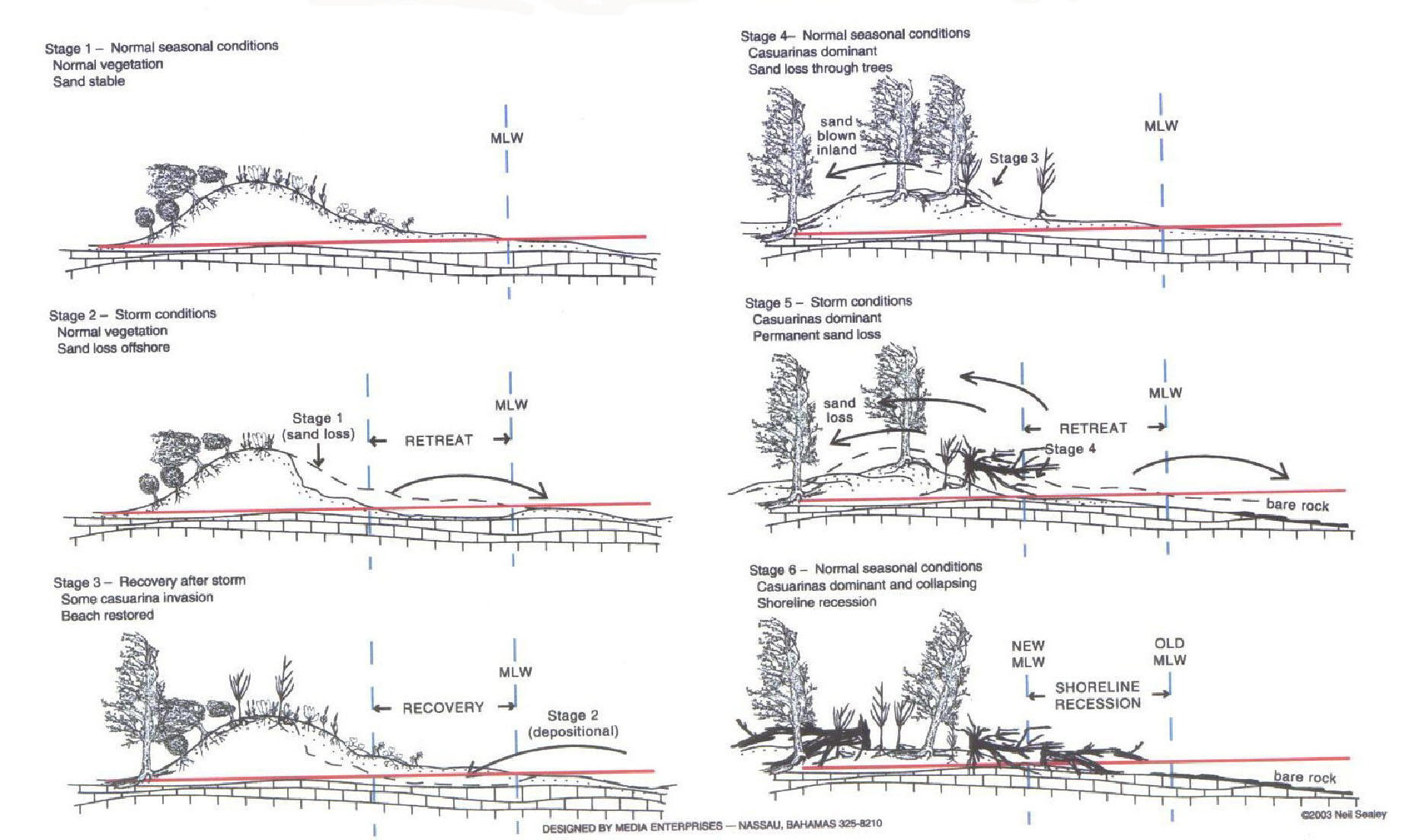
"Unlike native shrubbery, the thick, shallow roots of Australian pine make it much more susceptible to blow-over during high wind events, leading to increased beach and dune erosion and interference with the nesting activities of sea turtles.
The Florida Exotic Pest Control Council:
"Encourages beach erosion by displacing deep rooted native vegetation"
The Smithsonian Institute:
"The thick, shallow and wide-spreading roots are both disruptive to lawns and pavement and also make the tree prone to being overblown in strong winds (e.g., hurricanes). Casuarina equisetifolia grows too tall to be considered a safe ornamental tree given its tendancy to blow over."
"...the tree's thick, shallow roots actually make it more likely to be blown over in high winds than most coastal native trees. Wind-felled C. equisetifolia can exacerbate erosion on beaches and dunes..."
The Nature Conservancy:
"Very young Casuarina (Australian Pine) seedlings are capable of trapping sand because of their close scrubby growth, but once Casuarina grows beyond the sapling stage, it ceases to trap sand because of the lack of low, shrubby vegetation around the trunk. Casuarina monocultures are usually flat without dune-swale topography and lack diversity in understory vegetation. The shallow root systems of the trees makes them susceptible to toppling during storms (Digiamberardino 1986)."

The University of Miami:
"In areas where the Australian pine establishes, native, dune building species are out competed and the coastline becomes altered from a dune, stable coast to a flat, unstable shore with a recessed coastline, susceptible to erosion (Sealey 2003)."

Evolution of naturally vegetated beaches versus Casuarina sp. (Australian pine) dominated.Neil Sealey, 2003

9. Disposing of the Australian pines
Mr. Ellis complains "The people who are currently cutting down the Australian pines ... are not making any effort to save or use the wood." But he then goes on to say they are "grinding them up to make mountains of mulch." Hey, mulch is a use.

Beyond that, the number one use is as firewood. Not a lot of call for that in Florida. And before you can burn it, it takes 3-5 years to "cure." That's a fancy term meaning "dry out."

10. Replacing what has been destroyed
Mr. Ellis concludes that we'd save all kinds of money simply by not removing the trees. This is akin to saying that you can save money by not treating your cancer, or by not buying insulin to treat diabetes. Sure, you save the initial outlay, but in the end you pay more than you would have in the first place.

Sure, stands of Australian Pines are pretty. But the true cost of those "pretty trees" is higher than we should pay:
  • Destruction of property and endangerment of life and limb when the trees get blown over.
  • Increase in erosion along our beaches.
  • Loss of native habitat.
  • Destruction of native ecosystem
  • Extinction of endangered species.
Oh, hey, I forgot to tell you about the turtles and crocodiles!

I've described the thick roots of the Australian Pine. Here's photo of them along a beach.

Note that the roots create a fairly steep bank above the tide line. These exposed roots prevent turtles and crocodiles from accessing their nesting grounds. Not only do they have a hard time crossing the roots of the stand trees, where the trees have fallen over, the roots prevent turtles and crocodiles from getting to the zone of beach were they dig their nests.

But even if they get over and through the roots and find a place where they can dig their nests, there's too much shade; the eggs never hatch.

The fact of the matter is that Australian Pines really ARE destructive to our environment. I do agree that they should be replaced with native shade trees. It is unfortunate - but necessary - that those trees will take time to grow into the peaceful refuge on a sunny day. But better a few years of inconvenience than the ultimate destruction of habitat that is the only promise of Australian Pines.


Here's a bibliography of additional resources:
Binggeli P. 1997. Casuarina equisetifolia L. (Casuarinaceae), Woody Plant Ecology. Available online.

Duke J.A., 1983 Casuarina equisetifolia J.R. and G. Forst., Center for New Crops and Plant Products, Purdue University.

Elfers S.C. 1988. Element Stewardship Abstract for Casuarina equisetifolia. The Nature Conservancy. Unpublished report prepared for The Nature Conservancy on Australian pine. Winter Park, FL.

FLEPPC. 2005. List of Florida's Invasive Species. Florida Exotic Pest Plant Council. Available online.

Langeland K.A., and K.C. Burks (Eds.). 1998. Identification and Biology of Non-Native Plants in Florida's Natural Areas. UF/IFAS. 165 p.

Moler P.E. 1991. American crocodile nest survey and monitoring. Final Report to Study No. 7533, Florida Game and Fresh Water Fish Commission, Bureau of Wildlife Research, Tallahassee FL.

Morton J.F. 1980. The Australian pine or beefwood (Casuarina equisetifolia L.), an invasive "weed" tree in Florida. In: Proceedings,Florida State Horticultural Society 93:87-95.

Snyder S. A. 1992 SPECIES: Casuarina spp., U.S. Department of Agriculture, Forest Service, Rocky Mountain Research Station, Fire Sciences Laboratory, Fire Effects Information System.

Swearingen J.M. 1997. Australian Pine. Washington, D.C. National Park Service, Plant Conservation Alliance, Alien Plant Working Group. Available online.

Whistler W.A., and C.R. Elevitch. 2006 Casuarina equisetifolia (beach she-oak), C.cunninghamiana (river she-oak); Casuarinaceae (casuarina family). Species profiles for Pacific Island agroforestry ecological, economic, and cultural renewal. Available online.